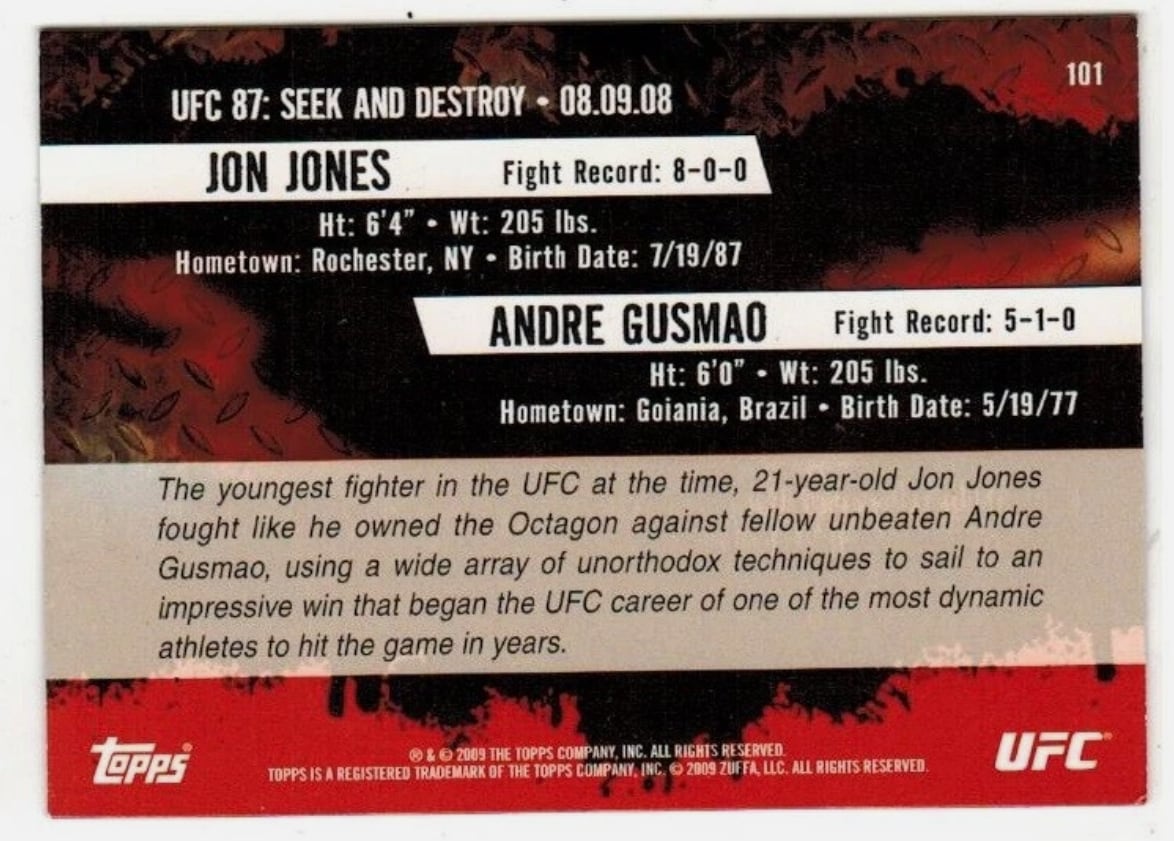
Search for Jon Jones's rookie card and you will be told, by more than one site that ought to know better, that it is a 2009 Topps UFC card numbered 101. That part is correct. The set those sites name is not.
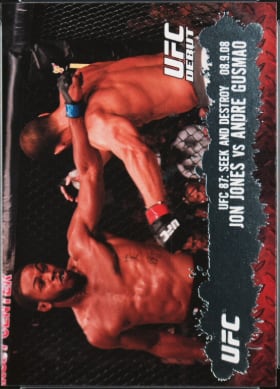
Topps released two UFC products in 2009. Round 1 has a 100-card base set. It stops at 100. There is no card 101, and there is no Jon Jones in it — not a portrait, not a bout card, nothing. Round 2 has a 150-card base set, and card 101 is Jon Jones / Andre Gusmao.
2009 Topps UFC Round 2, card #101, pictured with André Gusmão. It is Jones's only 2009 base card and his recognised rookie.
Why it is a two-man card
This is the part that explains everything else. Round 2's checklist is not 150 portraits. Cards 1 through 100 are single-fighter shots. Cards 101 through 141 are bout cards — two fighters, one photograph, one number — and Topps used that run to cover recent fights involving people who had no portrait card of their own.
In 2009 Jones was exactly that: a 21-year-old with two UFC wins and no profile. He did not rate a portrait. He got a bout card commemorating his debut, a unanimous decision over André Gusmão at UFC 87 on 9 August 2008. That is the photograph on the card.
Jones's rookie sits in the bout-card run at the back of the checklist, sharing a frame with his debut opponent.
How the error spreads
Three things compound. First, people write "2009 Topps UFC" and drop the Round, which is ambiguous on its face. Second, Round 1 came first, so it is the name that surfaces when someone half-remembers. Third, card sites cite each other. One early article gets the set wrong, the next one sources from it, and years later the mistake can outrank the correction.
The practical cost is real. Listings get filed under Gusmão. Titles say Round 1. Searching "Jon Jones rookie Round 1" returns sellers who copied a bad description, and searching "Round 2" misses everyone who did the same. Money gets left on the table in both directions.
Checking a card in thirty seconds
- Flip it. The number is on the back. It must read 101.
- Count the names. Both Jones and Gusmão appear. A solo Jones base card from 2009 Topps does not exist.
- Check the set line. Round 2. If a listing says Round 1 and the card genuinely reads 101, the listing is wrong, not the card.
- Check the photo. It is the Gusmão fight. Any later Jones bout means a later card.
The other 2009 Jones card
Round 2 also had a 45-card autograph set, and Jones is in it: #FA-JJ, his first certified autograph. It is a genuinely important card — arguably the key Jones autograph — and it is regularly listed as an “RC auto”. It is not the rookie. It is an insert, it carries no RC flag, and it has its own reported parallels, including a Red Ink version numbered to 25.
So the accurate version is: #101 is Jones's only 2009 base card and his rookie. #FA-JJ is his first autograph. An earlier version of this page said #101 was his only 2009 card. That was wrong, and it has been corrected.
What we do not know
Base print run: unknown. Not "estimated at" — unknown. No Topps figure for this set has turned up and we are not going to repeat someone else's guess so it can become a fact by repetition.
Parallel numbering: partly disputed. Cardboard Connection, Card Review Club and eBay listings all give Onyx as /188. TCDB calls the /188 parallel 'Silver' and adds a 'Bronze /88' that no other source confirms for 2009 — those are the 2010 Topps UFC parallel names, which is probably where the old /188 vs /88 confusion comes from. Onyx is /188; the /88 stays marked uncertain until a card is in hand or a sell sheet turns up.
If you have a #101 parallel numbered to 88, the back settles whether TCDB's 'Bronze' really exists for 2009. Send a scan and it gets credited as a source.
What the card actually is
A bout card picturing a UFC debut, from the back half of a checklist that used bout cards to cover fighters who had no portrait card of their own. Then Jones became arguably the best fighter in the sport's history, and card #101 became his recognised rookie card. That is often how it goes.